

Carbon vs. Fiberglass: Which Material Is Right for Your Padel Racket?
When looking for a new padel racket, you'll quickly come across terms like carbon, fiberglass, 3K carbon and EVA. They may sound technical, but what do these materials actually mean for your game? And is a carbon padel racket automatically better than one made with fiberglass?
The short answer is no. It's not just about the material itself, but about how the different components of a padel racket work together.
What's the Difference Between Carbon and Fiberglass?
Carbon fiber and fiberglass are two commonly used materials in the hitting surfaces of padel rackets.
Carbon fiber is known for its high stiffness relative to its weight. A stiffer hitting surface can provide a more direct and precise feel when striking the ball.
Fiberglass is generally more flexible. This allows the hitting surface to deform slightly more on impact, often resulting in a softer and more comfortable playing experience.
However, this doesn't mean carbon is only suitable for advanced players or fiberglass is exclusively for beginners. The overall construction of the racket is just as important.
Carbon vs. Fiberglass: The Key Differences
| Feature | Carbon | Fiberglass |
|---|---|---|
| Stiffness | Generally higher | Generally lower |
| Playing feel | More direct | Softer and more flexible |
| Ball impact | Less deformation of the hitting surface | More deformation of the hitting surface |
| Control | Depends on construction and player | Depends on construction and player |
| Price | Often more expensive | Often more affordable |
These are general material characteristics. Actual performance also depends on the fiber structure, resin, core, shape and balance of the racket.
Why a Full Carbon Racket Isn't Always the Best Choice
Padel isn't just about hitting the ball as hard as possible.
During a match, you often need quick reactions at the net, controlled volleys and enough touch to handle defensive shots.
A very stiff racket may feel great for some players, while others might find it less comfortable. Similarly, a more flexible racket doesn't necessarily mean less precision.
That's why it's worth looking beyond the words "100% carbon" when choosing a padel racket.
Combining Carbon and Fiberglass
A padel racket doesn't have to be made from just one material.
By combining carbon and fiberglass, manufacturers can bring different characteristics together in a single racket.
Carbon can contribute to structural strength and a direct response, while fiberglass can add flexibility to the construction.
How the racket ultimately performs depends on the proportion of each material, the arrangement of the layers and the type of core used.
And that's where significant differences between padel rackets can be found.
The Role of the EVA Core
Besides the hitting surface, the core of a padel racket has a major influence on how it feels during play.
Many modern padel rackets use an EVA foam core. EVA comes in different compositions and densities.
A softer core generally provides a more comfortable feel and deforms more easily on impact. A firmer core can offer a more direct response.
But once again, the core always works together with the hitting surface and the rest of the racket.
You simply can't judge how a racket plays based on one material alone.
How Does Pure32 Approach Material Selection?
At Pure32, we believe a great padel racket isn't defined by using as much carbon as possible or having the most impressive technical specifications.
Since our launch in 2018, we've focused on control, maneuverability and playing comfort.
It all started with our 32 mm padel rackets, developed around the idea that a racket shouldn't feel unnecessarily heavy or cumbersome.
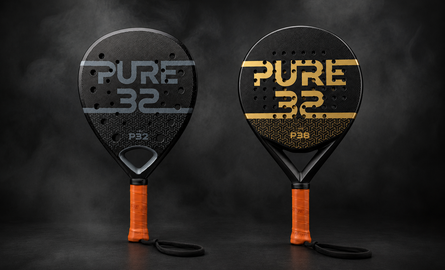
With our current Type P32 and Type P38, we continue that same philosophy.
The Pure32 Type P32 features a carbon frame and a hitting surface that combines carbon and fiberglass. Together with its Black EVA core, the construction is designed to balance responsiveness, control and comfort.
The Pure32 Type P38 follows the same philosophy in a 38 mm design, with an emphasis on stability, maneuverability and a comfortable playing experience.
Both rackets are developed using our own exclusive moulds. This allows us to tailor their shape and construction to the playing characteristics we believe matter most.

Which Material Is Right for You?
Looking for a new padel racket? Don't focus exclusively on carbon or fiberglass.
Instead, ask yourself a few questions:
Do you prefer a direct or softer feel when hitting the ball?
Is quick maneuverability important to your game?
How comfortable does the racket feel during longer matches?
Does the racket's balance suit your playing style?
Do you have enough control during both attacking and defensive shots?
Ultimately, how a racket feels on the court tells you more than its technical specifications alone.
Conclusion: It's All About the Right Combination
Carbon and fiberglass each have their own characteristics. Neither material is automatically better than the other.
A great padel racket is created when the hitting surface, core, weight, balance and shape work together.
At Pure32, our focus isn't on using as much carbon as possible. It's about creating a racket that feels comfortable, responsive and controlled on the court.
Curious to experience the difference?Discover the Pure32 Type P32 and Type P38 and find the racket that best suits your game.
Pure32 Padel – Control, maneuverability and playing comfort since 2018.